 Svenesis.org
My Equipment
Here I would like to introduce my three telescopes that I use for various astronomical activities. Each has its own strengths and I use them depending on the situation and what I want to observe or photograph.
My ZWO Seestar S30 Pro New
The Seestar S30 Pro is my newest smart telescope and represents a significant leap in technology. With its apochromatic quadruplet lens, the powerful Sony IMX585 sensor, and a unique dual-camera system, it delivers impressive results – all packed into a compact 1.65 kg device.
Optics & Sensor:
- 30mm f/5 apochromatic quadruplet lens (150mm focal length)
- Minimal chromatic aberration thanks to ED glass
- Main sensor: Sony IMX585 (8 MP, 4K, Starvis 2 – 4× greater light sensitivity than S30)
- Wide-angle sensor: Sony IMX586 (48 MP, 84° field of view for Milky Way panoramas)
Features:
- Built-in three-filter system (incl. Dark Field Filter for clean long-exposure images)
- 128 GB internal storage
- 6000 mAh battery (~6 hours), USB-C chargeable even while imaging
- Wi-Fi, Bluetooth & NFC connectivity
- Access to 80,000+ deep-sky objects and 600,000+ stars
- Milky Way mosaic mode with automatic stitching
- AI-powered image processing (DBE + AI Denoise)
- EQ mode for precise tracking of Earth's rotation
- ASCOM Alpaca protocol (compatible with NINA and other software)
- Built-in dew heater
- Daytime use possible (birdwatching, landscape photography)
Why I chose it:
The dual-camera system is truly unique: while the main camera captures deep-sky objects, the wide-angle camera simultaneously captures the big picture – perfect for breathtaking Milky Way shots. Compact, powerful, and travel-friendly.
My ZWO Seestar S50
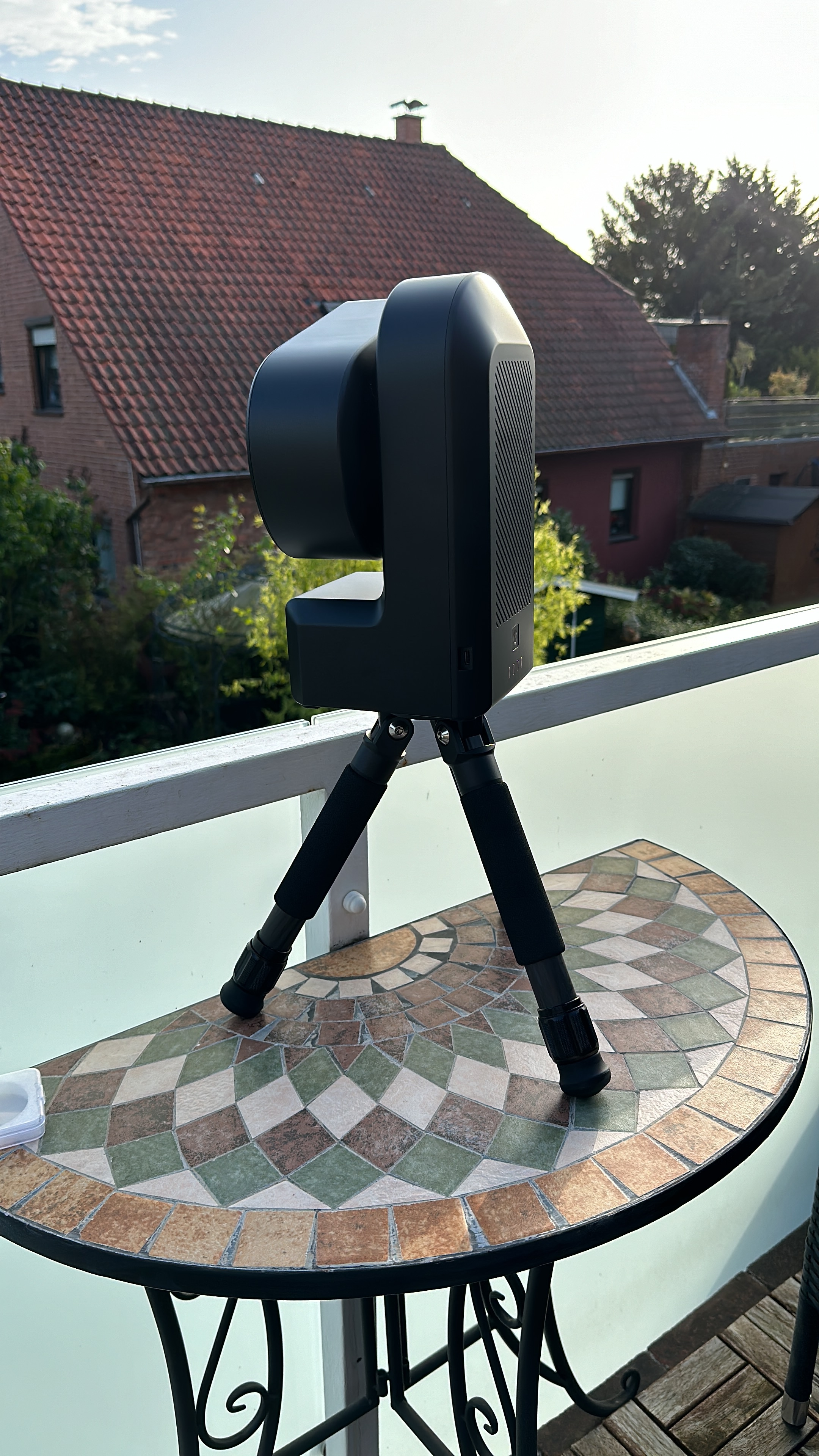
The Seestar S50 was my entry into modern astrophotography. What excited me: I can simply set it up on the balcony, connect it to my phone, and within a few minutes the first images of nebulae and galaxies appear.
What it can do:
- 50mm lens with excellent optics
- Built-in camera with cooling
- Automatically finds and tracks objects
- Filters already built in
- Runs via phone over Wi-Fi
- Battery lasts several hours
- Handles image processing automatically
What I use it for:
Mainly for deep-sky objects like the Orion Nebula, Andromeda Galaxy, or various star clusters. Especially practical when I want to quickly take a photo without setting up the big equipment.
Control:
Everything works via the Seestar app – from object selection to the finished image. Very user-friendly.
My TS-Optics APO with iOptron Mount
The Telescope – TS-Optics 115mm APO
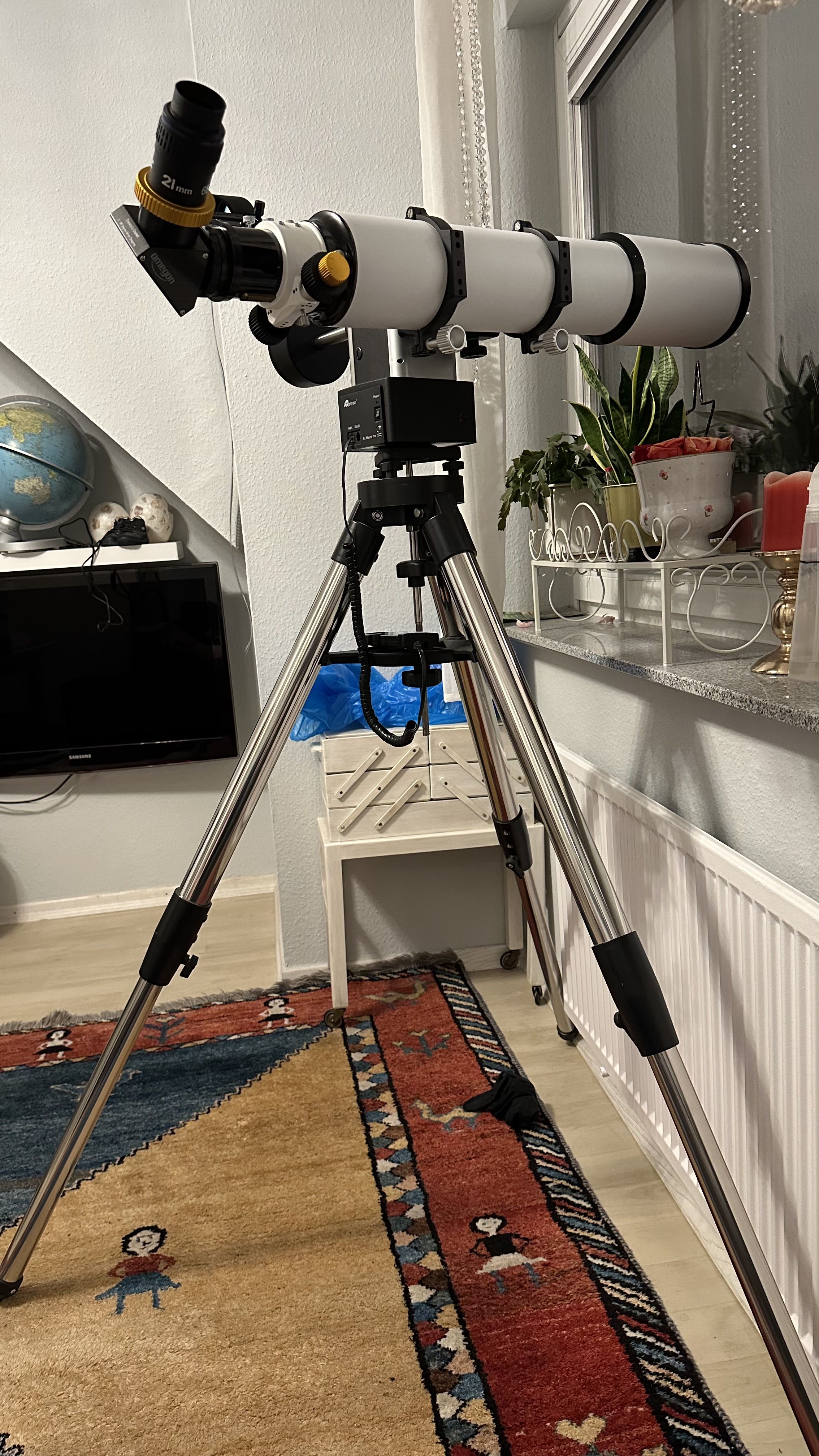
This is my "big" telescope for classical astronomy. I chose this APO refractor because it is very well suited for both visual observations and astrophotography.
The specs:
- 115mm aperture, 805mm focal length (f/7)
- Triplet lens with ED glass (very color-accurate)
- High-quality Japanese optics
- Virtually no chromatic aberration
- 2.5″ focuser with fine focusing
- Works well for visual and photography
The Mount – iOptron AZ Mount Pro
For the telescope I need a stable mount. The iOptron is an altazimuth GoTo mount that automatically finds and tracks objects.
What it can do:
- Automatically finds objects via two axes
- Easily supports the 115mm telescope
- Tracks objects very accurately
- Has GPS and knows its location
- Can be controlled via Wi-Fi
- Comes with a sturdy tripod
- Knows over 200,000 celestial objects
- Works with astrophotography software